 Daohaus
 ragequit burns membership tokens for a proportional withdrawal from the main treasury
Daohaus ragequit lets a member burn shares, loot, or both to withdraw a proportional amount of eligible main treasury assets. In the Safe-based Moloch v3 design, shares carry voting and financial rights; loot carries financial rights without votes. Before a first withdrawal, identify the main Safe, the assets included in the exit, and the membership balance you intend to surrender. Sidecar balances sit outside that claim. A smaller burn leaves some membership intact, while a successful burn permanently consumes the selected units. The payout follows treasury balances and total membership supply when the transaction executes.
Last updated ·
In a v3 ragequit, the token list determines which assets the burned membership units redeem.
The main treasury sets the boundary of your exit
One Safe is the ragequittable main treasury in a Moloch v3 DAO; additional sidecar Safes hold assets outside members' exit rights. The Safes view marks the main treasury with a ragequittable badge. A combined view of organizational assets can therefore exceed the balances available through ragequit. The treasury address identifies the account that supplies eligible assets for an exit on the DAO's network.
Settings lists the governance, treasury, voting token, and non-voting token contracts. These records connect the membership balance to the correct Safe. A matching token name elsewhere does not establish ownership in this DAO or a claim against its treasury.
Can I burn only part of my shares or loot?
V3 accepts separate burn amounts for shares and loot, so an exit can use part of either balance. Choosing shares spends voting tokens as well as financial weight. Choosing loot spends financial weight while leaving the share balance intact. Each burn amount must fit the initiating member account's holdings. The rights attached to any remaining tokens continue with that remaining balance.
Choosing a smaller amount makes the exit smaller; it does not make the completed burn reversible.
Each selected asset uses the same ownership fraction
In Safe-based v3, the withdrawal fraction equals the combined shares and loot burned divided by their combined supply before burning. That supply covers all holders. The contract multiplies each selected treasury asset's balance by this fraction. Integer division rounds down when the result includes a fraction of the asset's smallest unit. This calculation produces an amount of each asset. It does not calculate a cash value or return the member's original contribution.
Treasury spending can lower a payout, while deposits can raise it. Changes to membership supply also change the denominator. Those inputs come from the chain when the withdrawal executes. A displayed estimate can therefore change before inclusion, even when the burn amounts remain the same.
The asset list determines what this burn claims
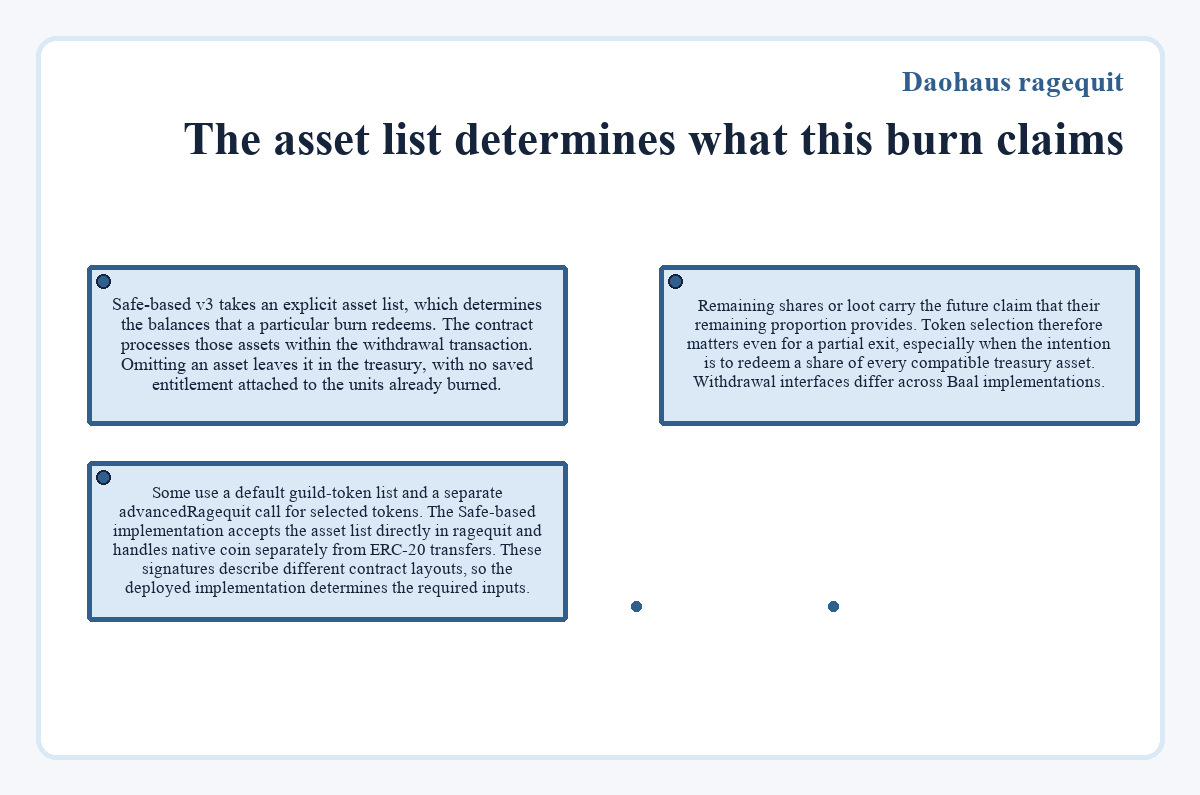
Safe-based v3 takes an explicit asset list, which determines the balances that a particular burn redeems. The contract processes those assets within the withdrawal transaction. Omitting an asset leaves it in the treasury, with no saved entitlement attached to the units already burned. Remaining shares or loot carry the future claim that their remaining proportion provides. Token selection therefore matters even for a partial exit, especially when the intention is to redeem a share of every compatible treasury asset.
Withdrawal interfaces differ across Baal implementations. Some use a default guild-token list and a separate
advancedRagequit
call for selected tokens. The Safe-based implementation accepts the asset list directly in
ragequit
and handles native coin separately from ERC-20 transfers. These signatures describe different contract layouts, so the deployed implementation determines the required inputs.
Proposal grace periods define time before execution
A proposal's grace period delays processing after voting ends, giving objecting members time to exit before that proposal executes. Its duration comes from the DAO's governance settings. A passing vote therefore does not immediately move the funds. An intended exit before a treasury transfer depends on the proposal's grace end and execution state. If the transfer executes first, the withdrawal uses the changed treasury balance. Governance can change configured timing, so a duration used by another DAO does not determine this window.
Member exits can also prevent proposal execution when the combined supply of shares and loot falls below the required retention level. That condition compares remaining combined shares and loot with a supply reference recorded for the proposal.
A first withdrawal can stop before signing
For a first partial exit, assume you want a payout from every intended compatible asset in the main treasury. Before approving the burn, decide whether that complete asset list can transfer at a gas cost you accept.
The main Safe supplies the assets, and the burned shares or loot supplies the ownership fraction. Gas pays for execution work, including membership burns, balance reads, and transfers with nonzero calculated payouts. Network fee conditions affect the price of that work.
- Match the DAO and main treasury contracts to the network used by the wallet.
- Keep each share and loot burn amount within the initiating member account's balance.
- Include every compatible asset intended for this burn; custom v3 arrays require unique, ascending addresses.
- Choose a recipient that can receive the selected assets and whose address matches the intended destination.
- Review the gas estimate for that exact withdrawal before approving the transaction.
Selecting fewer assets can avoid contract calls. It also gives up the claim that this burn would have redeemed on the omitted assets. Keeping the full asset list and reducing the burn amount preserves the range of assets involved while changing the fraction withdrawn. It does not proportionally reduce execution work.
If you proceed, a successful v3 withdrawal burns the selected membership units and transfers the calculated assets within the same transaction. The successful chain receipt, membership reduction, and recipient transfers should agree with the intended exit. A signature or transaction identifier alone does not establish that payout.
Stop before signing if the main Safe is wrong, an essential asset is absent, or the recipient differs from the intended address. Declining an unsubmitted wallet request leaves the balances unchanged. Any revised asset list requires reconsidering which payout the burn will actually claim.
Token calls and recipient behavior can prevent completion
An incompatible or malicious token can make its balance unreadable or cause its transfer to fail. The withdrawal also relies on the main Safe's module permissions. If a required asset transfer reverts, the v3 transaction also rolls back its membership-token burn. A contract recipient that rejects a native-coin payment can prevent completion too. Excluding a troublesome token changes the payout covered by that burn, so it requires a new decision about the exit.
Completed burns leave transaction and balance records
A successful v3 withdrawal emits a
Ragequit
event identifying the member, recipient, burn amounts, and selected tokens. Membership reductions and treasury transfers establish what the exit changed. The event identifies the selected assets; it does not specify every transferred amount. An asset whose calculated payout rounds to zero produces no transfer. A successful transaction therefore needs interpretation alongside its asset movements, especially if an intended token was absent from the list.
Still have questions?
Can the payout go to a different wallet from the member account?
V3 allows the member to name a separate recipient for the payout. The member account supplies the burned shares or loot, while the recipient receives the selected treasury assets. Changing the recipient does not change whose membership balance funds the exit. A contract recipient must support receipt of the selected assets.
Does vote delegation let the delegate ragequit my tokens?
Delegating votes alone does not authorize the delegate to burn the token holder's shares or loot. Delegation assigns voting power. The v3 withdrawal instead burns membership tokens from the member account that initiates it. Voting weight assigned to a delegate is therefore different from that delegate's own token balance.
Do I need a proposal before a v3 ragequit?
A standard v3 ragequit uses the member withdrawal function without a separate proposal authorizing that exit. It burns the initiating member's selected shares or loot and claims eligible main treasury assets. The configured proposal offering concerns proposal submission. It is a separate mechanism from the member's withdrawal and its network execution cost.
Will the withdrawal split an NFT held in the main Safe?
The standard v3 ragequit calculation does not divide an NFT among exiting members. Its native-coin and ERC-20 branches use fungible balances. A Safe's ability to hold ERC-721 or ERC-1155 assets does not make those assets automatic ragequit payouts. Moving an NFT requires an action that supports its token standard and specific asset.
Which token-list mistake causes the !Order error in v3?
The Safe-based v3 function rejects an asset array unless its addresses are unique and strictly increasing. This rule concerns the numeric order of addresses in transaction data, rather than alphabetical ticker names. A duplicate address also breaks the rule. The contract checks this ordering before burning shares or loot.